
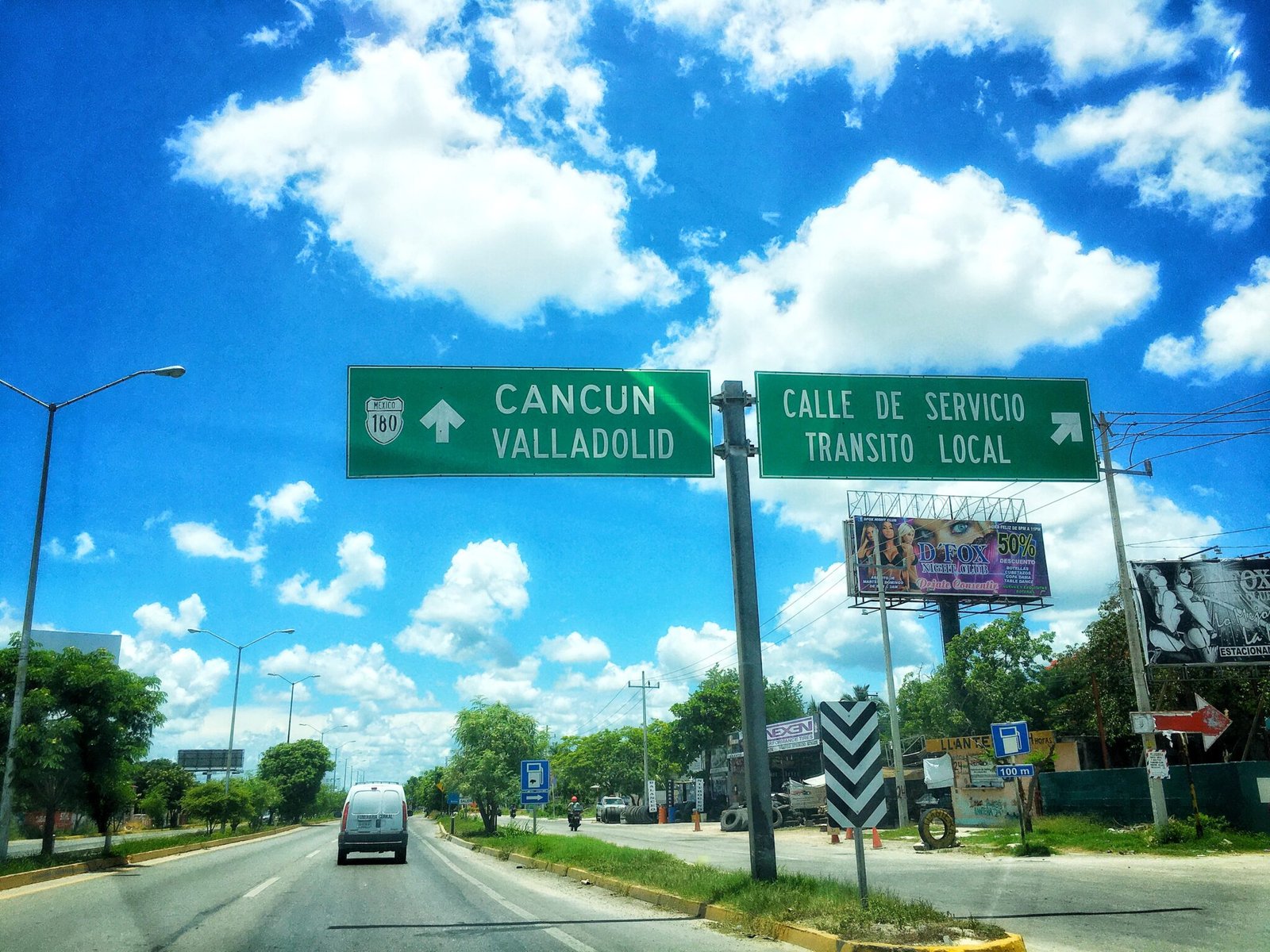
Mérida to Cancun Highway: Everything You Need to Know (2026 Update)
If you pull up a map of the Yucatán Peninsula, you’ll notice something almost too convenient: Mérida and Cancún are connected by one nearly straight line. That line is Highway 180D — known locally as the cuota or the Autopista Mérida-Cancún. It’s the road most of us at Life in Mérida™ have driven dozens of times, whether for a weekend on the Caribbean coast, an airport pickup, or a quick run to Valladolid.
But the Mérida to Cancun highway in 2026 isn’t quite the same road I started driving when I lived in Riviera Maya in 2006. Toll prices have climbed sharply, the cashless transition is changing how you pay at the booths, and the Maya Train now runs roughly parallel to the route — giving you a real alternative for the first time in decades.
Here’s the local’s-eye view of what to expect, what it costs, and a few things I wish someone had told me before my first trip across.
📌This article was originally posted on September 9, 2020 and has been updated with current ticket pricing and other details for 2026.
Is the Mérida to Cancun highway safe?
Short answer: yes. The highways across the Yucatán Peninsula are some of the safest stretches of road in Mexico, and the Mérida to Cancun highway is the flagship of that network. It was built with tourism in mind, the surface is well-maintained, and it’s a four-lane divided highway almost end to end.
You’ll usually see police vehicles stationed near the Yucatán/Quintana Roo state line, but they don’t typically pull anyone over — you’ll just want to slow down as you pass. Speed limit is 110 km/h (about 68 mph), and Yucatán state police do enforce it with radar, so set your cruise control and don’t get fancy.
A few honest notes from my own driving experience:
- It’s flat. Really flat. The peninsula is a giant limestone shelf, and the highway reflects that. Long, monotonous stretches with very little to look at. Bring a podcast, a co-pilot, or both.
- Avoid driving at night when you can. Wildlife crosses the road, lighting is minimal to non-existent, and your visibility drops fast. Hardly anyone drives at night unless they have to. The road can be incredibly dangerous in the dark.
- Cell service is spotty in the middle stretch. Download your map offline before you leave.
How much are the tolls on the Mérida to Cancun highway in 2026?
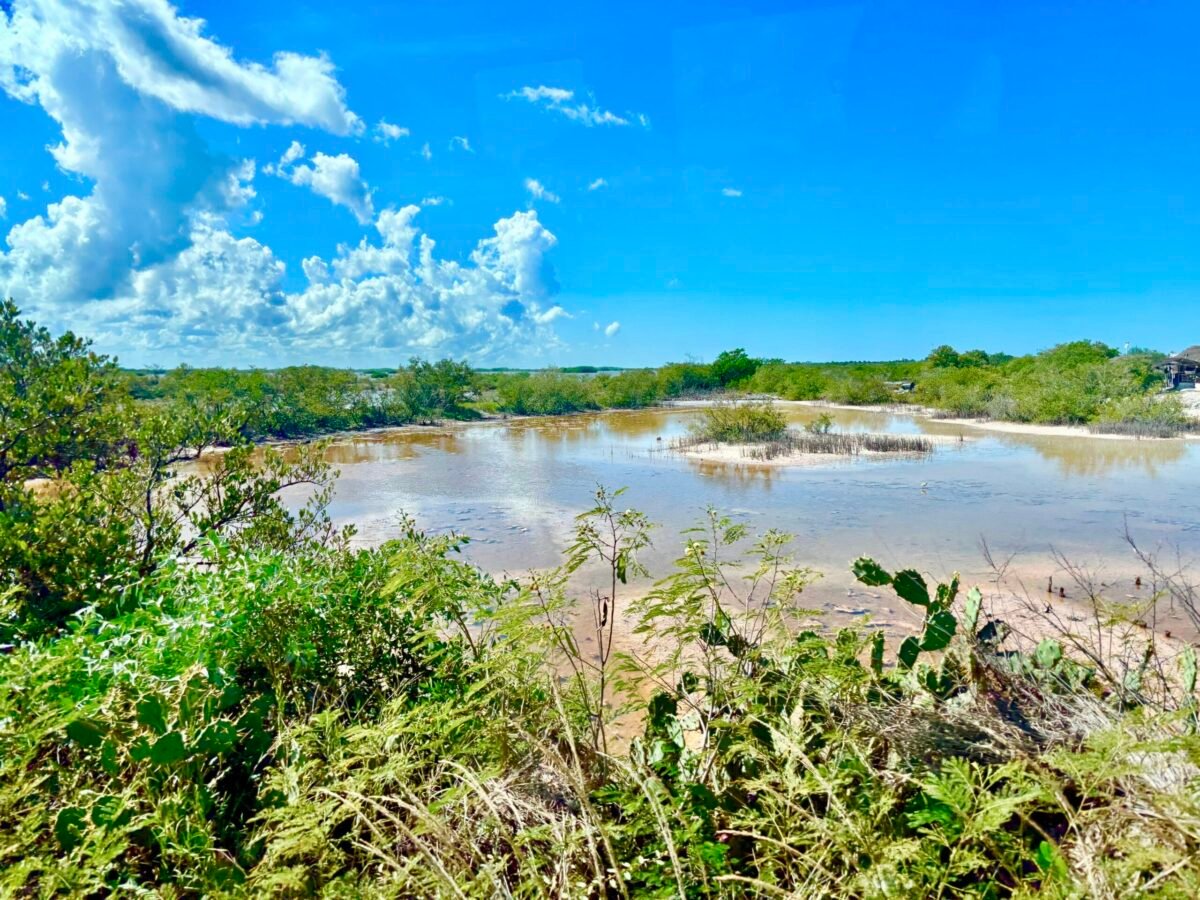
This is where the biggest changes have happened. If you read older articles (including the original version of this one), you’ll see toll figures from 2021 — and they’re now badly out of date.
As of the 2026 toll adjustment, the rates for a standard passenger car on the Mérida to Cancun highway are:
| Segment | Toll for cars (2026) |
|---|---|
| Mérida ↔ Valladolid | $248 MXN |
| Valladolid ↔ Cancún | $427 MXN |
| Full route Mérida ↔ Cancún (end-to-end) | $675 MXN |
Motorcycles pay $337 MXN end-to-end. Cargo vehicles, RVs, and buses pay considerably more — up to $1,322 MXN for the largest vehicle classes.
Yes, it’s expensive. That’s actually one of the reasons the road never feels crowded — many local drivers and trucks still take the old free route (Highway 180, the libre) through the small Yucatecan towns. The trade-off: the libre adds about 1.5 to 2 hours and a lot of speed bumps.
Driving time on the Mérida to Cancun highway itself is roughly 3.5 to 4 hours door to door, assuming no major weather or stops.
How do you pay tolls in 2026? (This part has changed.)
This is the update that catches most travelers off guard. Mexico’s federal toll system, CAPUFE, began transitioning toll booths to electronic-only payment starting in January 2026. Cash lanes are being reduced and will eventually be phased out entirely. Credit cards are no longer accepted at most booths. So your options on the Mérida to Cancun highway look like this:
1. Cash (pesos only). Still works at most booths along the route as of this writing, but the cash lanes are getting shorter every quarter. Always have enough Mexican pesos in small bills for both toll plazas — don’t count on getting change for a $500 peso note.
2. Electronic TAG (the smart move for residents and frequent drivers). If you live here or plan to make this drive more than once or twice a year, get yourself an IAVE or PASE TAG. It’s a small windshield sticker linked to a prepaid balance. You drive through the dedicated TAG lane without stopping, and the toll is deducted automatically. You can pick one up at most Bancomer/BBVA branches, larger Sanborns, and selected OXXO stores. Reload online or via the UnDosTres app.
3. The “I forgot cash” backup. Some plazas allow a SPEI bank transfer if you have a Mexican bank account. It works, but it adds 10–15 minutes and isn’t guaranteed at every booth.
If you’re flying in and renting a car at CUN airport for a one-time trip, cash is still your easiest play — just hit an ATM in Cancún before heading west.
Are there gas stations on the Mérida to Cancun highway?
Fewer than you’d expect. This is one of the most repeated questions I get from people prepping their first scouting trip, and the answer matters because running out of gas mid-peninsula is genuinely miserable.
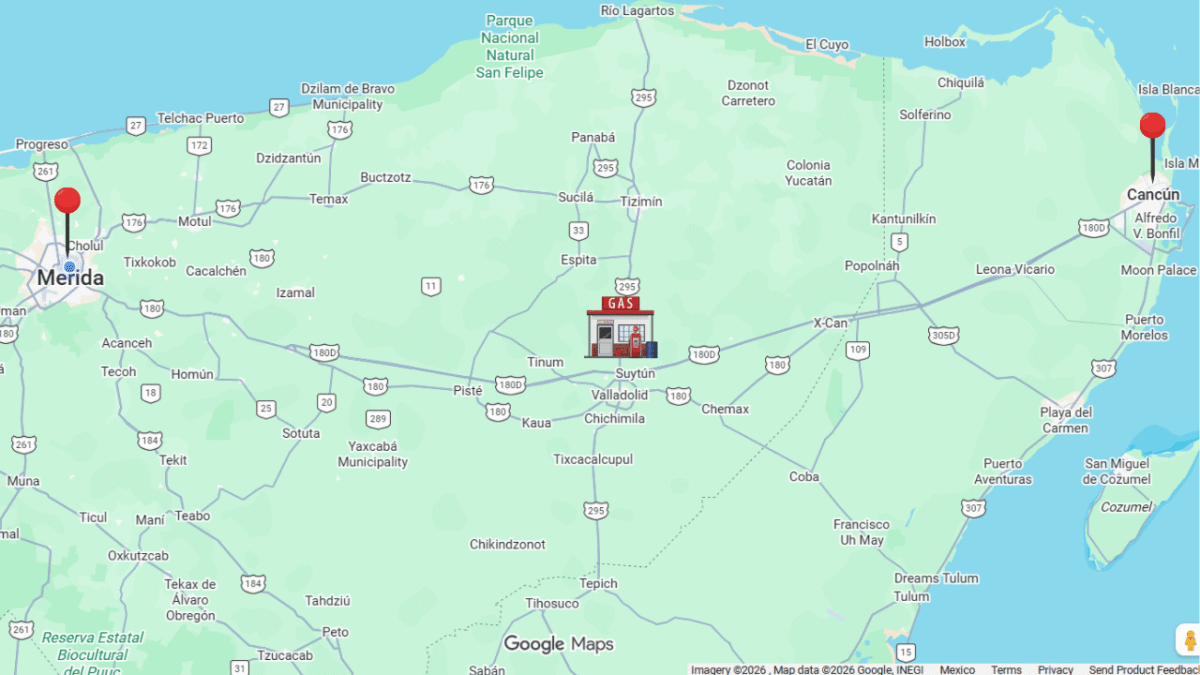
Heading east from Mérida, you’ll pass several Pemex stations in the first 10–15 minutes. After that, gas stations become scarce until you approach Hwy 295 which is also the turn to Valladolid. Note: Valladolid is NOT on this highway. You’ll have to turn south on Hwy 295. Coming the other direction — westbound from Cancún or Playa del Carmen — fill up before you leave town. Even the Cancún and Playa exit corridors have surprisingly few stations on the way out.
My rule: never start a trip on the Mérida to Cancun highway with less than a full tank of gas. Top off anywhere along the way when you see a station, and you’ll have zero stress.
A note on etiquette: the attendant who pumps your gas can also clean your windshield and check your tire pressure. That earns a tip — $10–20 pesos is the going rate, a little more if they did the tires.
Where can I stop for food, coffee, or a bathroom break?
Honestly? The pickings are slim along the Mérida to Cancun highway. The main “services” plaza sits near the Valladolid exit and includes:
- A Subway and an Italian Coffee Company kiosk
- A small Mexican-style canteen
- A couple of basic shops
- Bathrooms (the only reliable ones between the two endpoints)
If you’ve got an extra hour and a half to spare, take the Valladolid exit. The colonial center is about 20 minutes off the highway, and the food is dramatically better than anything in the rest area. Yucatecan classics, real cochinita pibil, cenotes nearby — it’s worth turning a 4-hour drive into a 6-hour day ONLY if you can arrive into Mérida before dusk.
What about the Maya Train as an alternative?
This is the question I’m hearing most often in 2026, and it deserves a real answer rather than a sidebar.
The Maya Train (Tren Maya) now runs from Cancún Airport (Terminal 4) to Mérida-Teya station, with stops at Valladolid, Chichén Itzá, and Izamal along the way. Travel time is roughly 4 to 4.5 hours in standard class — comparable to driving, sometimes faster, sometimes slower depending on your luck with traffic.
Quick honest comparison if you’re weighing the train against the Mérida to Cancun highway:
- Take the train if: you don’t want to drive, you have lots of luggage, you’re traveling solo, or you actually want to read/sleep/look out the window. Tickets start around $400 MXN economy.
- Drive the highway if: you want a straight shot into Mérida, want to travel on your own schedule with flexibility, or you’re moving more stuff than will fit on a train.
The Mérida-Teya station is about 15–20 minutes by Uber from Centro, which is worth factoring in if you’re trying to compare door-to-door times honestly.
Local tip: IF this is your first visit to Mérida, make it easy on yourself and fly direct into Mérida International Airport. Schlepping luggage, dealing with transporation to and from the train stations, and possible delays requires mental strength!
Final tips for driving the Mérida to Cancun highway
A few things I’ve learned the hard way over six years of making this drive:
- Bring all your travel documents. There’s been ongoing chatter about Mexican immigration enforcement; whether or not it affects you personally, carry your passport (not a copy). If you are a resident, carry your residency card (not a copy). If you are a tourist, carry your tourist permit (not a copy).
- Don’t travel completely alone if you can avoid it. Not for safety reasons — just because the drive is long, monotonous, and a co-pilot makes a real difference at hour three.
- If you don’t have your own car, I recommend renting through Mayan Drive Rental Car. They’re a small local operation that’s worked well for our scouting trip clients.
- Pack a small kit: water, snacks, sunglasses, phone charger, toilet paper, a roll of small bills for tolls, and a paper map as backup. Cell signal will fail you somewhere in the middle. Don’t take anything for granted.
- Check the weather. Hurricane season (June–November) can shut sections of the highway briefly, and heavy rain on a flat road creates serious hydroplaning risk.
Safe travels — and welcome to the road
The Mérida to Cancun highway has carried me to and from more flights, beach weekends, and friend pickups than I can count. It’s not a scenic drive in the traditional sense, but it’s one of the most reliable ways to experience the geography of the peninsula firsthand — the long flat run between two very different coasts.
If you’re researching the Mérida to Cancun highway because you’re thinking about moving here or scouting Mérida as a possible new home base, that’s exactly the kind of question we love helping with.
Buen viaje. ¡Nos vemos en la carretera!
— Amy The Mérida Ambassador Co-founder, Life in Mérida™