
The La Ermita Neighborhood in Mérida: A Hermit, Henequen Kings, and Bricks from Canton, Ohio
A historical walk through Yucatán’s first Barrio Mágico
If you’ve spent any time walking the south end of Centro, you’ve felt the change underfoot. The pavement turns red. The streets narrow and slow down. The houses lean in close. You’ve crossed into the La Ermita neighborhood of Mérida — and you’ve also stepped onto one of the most well-traveled stretches of road in Yucatán’s history.
This is the neighborhood Mexico’s Secretaría de Turismo named Yucatán’s first Barrio Mágico in 2023. But long before that federal designation — long before the foreign residents, the telenovela film crews, the boutique hotels — the La Ermita neighborhood in Mérida was the last stop on a hard road, the favored project of a wealthy hermit, and, improbably, the recipient of one of the largest brick shipments ever to leave the state of Ohio.
Here’s the story most walking tours don’t tell.
📌This article was originally posted on April 11, 2021. With new found information on the bricks and legends, it’s been updated for 2026.
A hermit, a chapel, and the road to Campeche
The Spanish founded Mérida on January 6, 1542, on top of the Maya city of T’hó. Within a generation, the city’s outer edges began to grow into what Mérida’s chroniclers still call its eight historic barrios — neighborhoods clustered around small chapels, each with their own market, patron saint, and personality.
The La Ermita neighborhood in Mérida was the southernmost of them, and it grew up around an actual hermitage. The word ermita in Spanish refers to a remote chapel, often built outside a town’s walls, sometimes inhabited by a hermit who lived a solitary religious life. That is almost certainly what happened here. According to Mérida chronicler Gonzalo Navarrete Muñoz, a man named Gaspar González de Ledesma built the chapel with his own money and moved in to live as a hermit. He believed — as did many wealthy men of his time — that constructing a temple was a more reliable path to heaven than mere piety.
Historians disagree about exactly when this happened. Some sources place González de Ledesma in the 16th century, others in the 17th. What is certain is the stone inscription carved over the chapel’s main entrance: 1748. That date almost certainly marks a major reconstruction rather than an original founding.
For most of the colonial period, the chapel had a different name. It was known as Nuestra Señora del Buen Viaje — Our Lady of the Good Voyage — because of where it sat. Right outside it began the Camino Real, the royal road that ran 200 kilometers west through dense jungle to San Francisco de Campeche. In an era of bandits, snakes, fevers, and worse, travelers stopped here to pray for protection before riding out. When they came back alive, they stopped again to give thanks. Mérida had no shortage of grander churches, but this small, square chapel with its three-bell belfry was the city’s good-luck charm. It was eventually rededicated to Santa Isabel, the mother of John the Baptist.
Around the chapel, a community grew. Carriages parked outside the city walls at night, since Mérida’s gates closed at sundown. Travelers ate, slept, prayed. By the time the Camino Real was fully built out in 1790, the La Ermita neighborhood of Mérida had become the city’s effective edge of the world — the last familiar place before the road got long and serious.
The henequen boom that changed everything
Then came henequen.
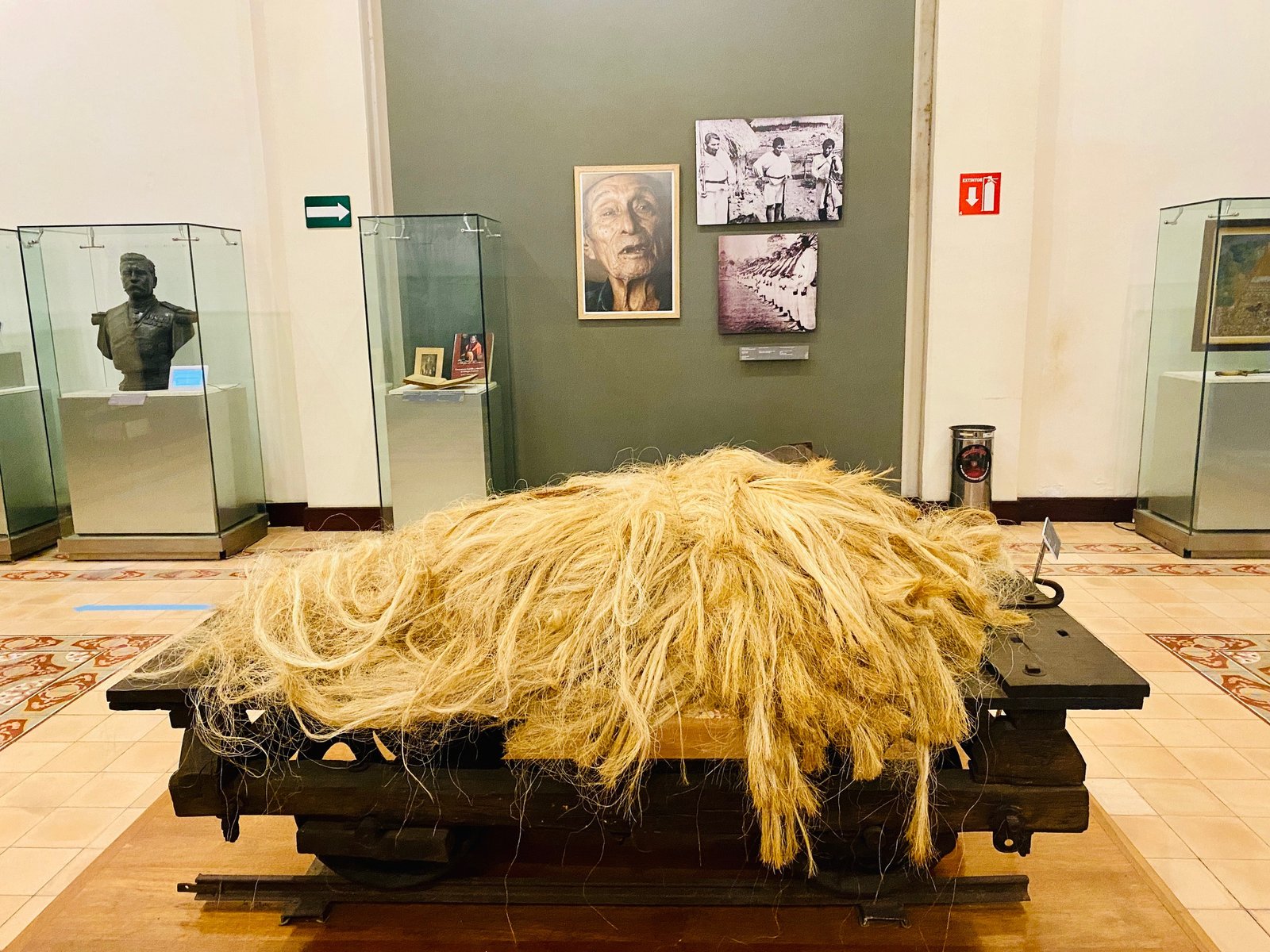
The agave fiber Yucatecans call sisal turned the peninsula into one of the richest places in the world in the late 19th century. Henequen was used for ship’s rope and, more profitably, for the binder twine that bundled American and Canadian wheat harvests. Demand was bottomless. Money flowed into Mérida the way it had once flowed into the silver towns of central Mexico.
The henequen barons were ambitious. They built the Paseo de Montejo to mimic the boulevards of Paris. They installed electric streetlights and electric trams in Mérida before Mexico City had them. They imported French furniture, Italian marble, and — most importantly for our story — railways and bricks.
In 1875, the first railroad in Yucatán was inaugurated between Mérida and the port of Progreso, 35 kilometers north on the Gulf of Mexico. The line was built to move henequen out. But it also opened up an unprecedented capacity to bring goods in. By 1902, the various competing rail lines were merged into a single company, Ferrocarriles Unidos de Yucatán, with Progreso as the peninsula’s only deep-water gateway.
The same year, 4,000 kilometers north in Ohio, three large brick companies merged to form a new firm: The Metropolitan Paving Brick Company of Canton. By 1911, Metropolitan was the largest paving brick manufacturer in the world. Its plants employed 600 people and shipped more than 100 million vitrified bricks every year — roughly one in every eight pavers made in the United States.
Metropolitan’s bricks were not ordinary clay bricks. They were “vitrified” — fired at extreme temperatures until the clay turned glass-hard and waterproof. Cities across North America were paving their muddy main streets with them.
So were the henequen kings of Mérida.
Three million bricks from Canton, Ohio
Here is the part you will not see on a plaque.
In a March 1914 article in the U.S. trade journal Better Roads, an Ohio paving contractor described the Metropolitan Paving Brick Company’s largest international shipment: “One of the largest hauls via rail and water of Metropolitan paving brick was a large shipment to Merida, Yucatan, Mexico, of over three million paving brick, or approximately 500 car loads.”
Three million bricks. Five hundred railcars.
Those bricks rode the rails out of Canton, almost certainly down to a Gulf port — most likely New Orleans, the long-standing trade partner of the henequen industry — and then onto cargo ships steaming south to Progreso. There they were transferred to the wide-gauge railway and brought the final 35 kilometers into Mérida and laid down across the La Ermita neighborhood.
You can still find references claiming the bricks came from “Cincinnati,” from “Chicago,” or from “France.” All three stories circulate widely. None is supported by the primary record. The bricks paving the streets around La Ermita today are vitrified clay pavers from Canton, Ohio — installed during the peak of what Yucatecans call the “green gold” era to modernize the city and put an end to the dust and mud of an unpaved Centro.
A century later, those same bricks are still doing their job. They give the neighborhood its distinctive red color, its slow pedestrian pace, and the gentle hum of car tires that anyone who has spent an afternoon at La Ermita or walking back from the Paseo de las Ánimas will recognize immediately.
The garden behind the wooden door
The chapel itself is worth a visit. So is the small park across from it, with its kiosk and its iconic S-shaped sillas confidentes — the two-seater “confidante chairs” designed so people can converse face to face.
But the real secret of the La Ermita neighborhood in Mérida is around the right side of the chapel, behind a plain wooden door.
When Gaspar González de Ledesma built his hermitage, the property included not just the chapel but a small cemetery, a tiny oratory chapel for funeral processions on their way to the General Cemetery, and a huerto — a kitchen and medicinal garden. A small windmill once stood in the central patio to draw water for the plants.
What survives today is a shaded botanical garden of native Yucatecan species: medicinal plants, ornamental shrubs, ferns, regional flowers, and — most importantly — mature trees from the peninsula. Stone paths wind through the space, and scattered among the plantings are vestiges of older Maya stone figures. The garden is usually closed during the week and often open on weekends, especially Sunday mornings during the Biciruta. If the door is open, knock and ask. Entry is free.
For a neighborhood whose history is bound up with the journeys of strangers, the garden does what gardens have always done in Yucatán. It holds the heat at bay, keeps the indigenous botany alive in the middle of a colonial city, and offers a few quiet minutes to anyone who came in off the road and needed to sit down.
Why the La Ermita neighborhood in Mérida feels different
There’s a reason this neighborhood reads differently from the rest of Centro. The streets are laid out on a diagonal, not the strict grid Mérida is otherwise known for, because they followed the curve of the Camino Real. The pavement is red. The houses are colonial casonas with 18-foot ceilings. And the soundscape is unusually quiet — partly because longtime residents have politely asked that it stay that way.
In 2023, Mexico’s Secretaría de Turismo formally recognized the La Ermita neighborhood of Mérida, along with the adjacent barrios of San Sebastián and Xcalachén, as Yucatán’s first Barrio Mágico. The designation comes with conservation funding, tourism promotion, and — for those of us who have come to know this corner of the city well — a measure of relief that the bricks, the chapel, the garden, and the slow afternoons are now formally protected.
When you walk the La Ermita neighborhood in Mérida, you’re walking a road that has been a road for almost five centuries. The hermit is long gone. The henequen kings are dust. But the chapel still keeps watch over the road south, the garden still grows, and three million bricks from Canton, Ohio still hold the street together under your feet.
That’s the real magic of Yucatán’s first Barrio Mágico.
Sources
The historical material in this article was drawn from the following primary and secondary sources.
On the Canton, Ohio brick shipment:
- A. P. Maurer, “A Good Road,” Better Roads, Vol. IV, No. 3 (March 1914) — the primary contemporary source describing the Metropolitan Paving Brick Company’s three-million-brick shipment to Mérida (approximately 500 railcar loads).
- Ironrock / METROBRICK corporate history, Canton, Ohio — descendant company of The Metropolitan Paving Brick Company, founded 1902 by merger of three Canton-area brick firms.
- “Reclaimed Metropolitan Street Bricks” historical notes, Experienced Brick and Stone — manufacturing and shipping history of Metropolitan Paving Brick Co.
- “Brick Streets,” Historic Ridgewood — confirmation of Canton as the center of the U.S. paving brick industry by 1892.
On the chapel and the hermit:
- Catálogo de Construcciones Religiosas de Yucatán — the official catalog entry for the Ermita de Santa Isabel.
- Abelardo Barrera Osorio, Mérida Colonial — cited for the 16th-century founding tradition by Gaspar González de Ledesma.
- Gonzalo Navarrete Muñoz, Cronista de Mérida — quoted in “La Ermita de Santa Isabel: Historia viva,” 24 Horas Yucatán (November 22, 2024).
- “Muros de fe: la Ermita de Santa Isabel, parada obligada para los viajeros,” Sipse / Novedades Yucatán (November 25, 2016).
On the church grounds, garden, and conservation history:
- “Reflexiones sobre la conservación del parque de la ermita de Santa Isabel,” SciELO México — academic article on the historical evolution of the chapel grounds, original cemetery, oratory, and surviving botanical garden.
- “Ermita de Santa Isabel (Mérida, Yucatán),” Wikipedia en español.
- “La importancia de la Ermita de Santa Isabel en la memoria histórica de Mérida,” Metrópoli Mid.
On henequen, railroads, and the port of Progreso:
- Allen Wells, “All in the Family: Railroads and Henequen Monoculture in Porfirian Yucatán,” Hispanic American Historical Review (Duke University Press, 1992).
- “The multiple memories of the train in Yucatán,” Revista Landuum.
- “How Progreso became what it is today,” The Yucatan Times (October 12, 2022).
On the Barrio Mágico designation and present-day neighborhood:
- “Mérida to have its first official Magical Neighborhood,” Mexico News Daily (July 21, 2023).
- “Three Official ‘Barrios Mágicos’ in Merida: La Ermita, San Sebastián & Xcalachén,” MID CityBeat (August 29, 2023).
- “La Ermita is one of the most peaceful Barrios in Downtown Merida,” The Yucatan Times (September 13, 2024).
- “Ermita Park – The start of the original road to Campeche,” Yucatán Magazine.
