Calling 911 in Mérida: Why It Shouldn’t Be Your First Call in a Medical Emergency
A foreign resident’s honest look at how emergency response actually works in Mérida — and a smarter plan to devise before you ever need it.
The first time I really thought hard about how to handle a medical emergency in Mérida, I read a story in a Facebook group. A woman collapsed at home in Centro. Her husband called 911. Here’s the lengthy timeline from the initial call to arriving at the closest hospital:
- 40 minutes to find an English-speaking operator
- 20 minutes for the police to arrive
- 15 minutes for Google translate to translate the issue and for the police to call the ambulance
- 20 minutes for the ambulance to arrive
- 15 minutes to get to the nearest hospital
Almost 2 hours total for a medical emergency. Fortunately, it wasn’t life-threatening. I hate to think what the outcome would have been if it were more serious.
That is not how most of us learned to think about emergencies. In the U.S., the model is simple: you dial 911, and within a few minutes a fully equipped ambulance with trained paramedics rolls up to your door. That is the model most of us move here with. And in Mérida, that model doesn’t exist.
Don’t get me wrong. I’m not saying 911 in Mexico doesn’t work. What you need to be aware of is that it works differently than it does back home. Knowing the difference — and having a plan that reflects it — is one of the most important pieces of preparation any foreign resident can do.
What we assume about calling 911 in Mérida 911 — and what’s actually true
Yes, 911 works in Mexico. The country rolled it out as the unified national emergency number starting in October 2016. Yucatán went live on June 1, 2017. Before that, there were 066, 089, and a tangle of more than two hundred local numbers. The unification was a real improvement.
But “it exists” and “it works the way you’re used to” are two very different things.
A few things to know about calling 911 in Mérida:
The system is overwhelmed by prank calls.
As of September 2025, more than 73% of all incoming 911 calls in Mexico were classified as improcedente — obscene calls, joke calls, or insults. That percentage has been declining since the early days of the system when it hit 90%. But the fact remains that these improcedente calls dominant the share of incoming volume. Operators are under real pressure to verify calls are legitimate before dispatching resources. That verification costs you time.
Patrol cars are sent first.
Here, a police unit is dispatched first to assess whether the call is real before an ambulance is sent. By the time an ambulance is actually rolling toward you, valuable time has passed. That process costs you time.
English support is thin.
The State of Yucatán provides 911 service around the clock, with multiple Spanish-speaking operators on duty. It also has exactly one bilingual English/Spanish operator on duty at a time. Officially, you can ask for ayuda en inglés and you’ll be transferred. If that one operator is already on another emergency call when you dial in, you wait. Sitting on hold for the only English-speaking operator on shift is not the situation you want to be in during a real crisis. That process costs you time.
The ambulance that comes is probably Cruz Roja.
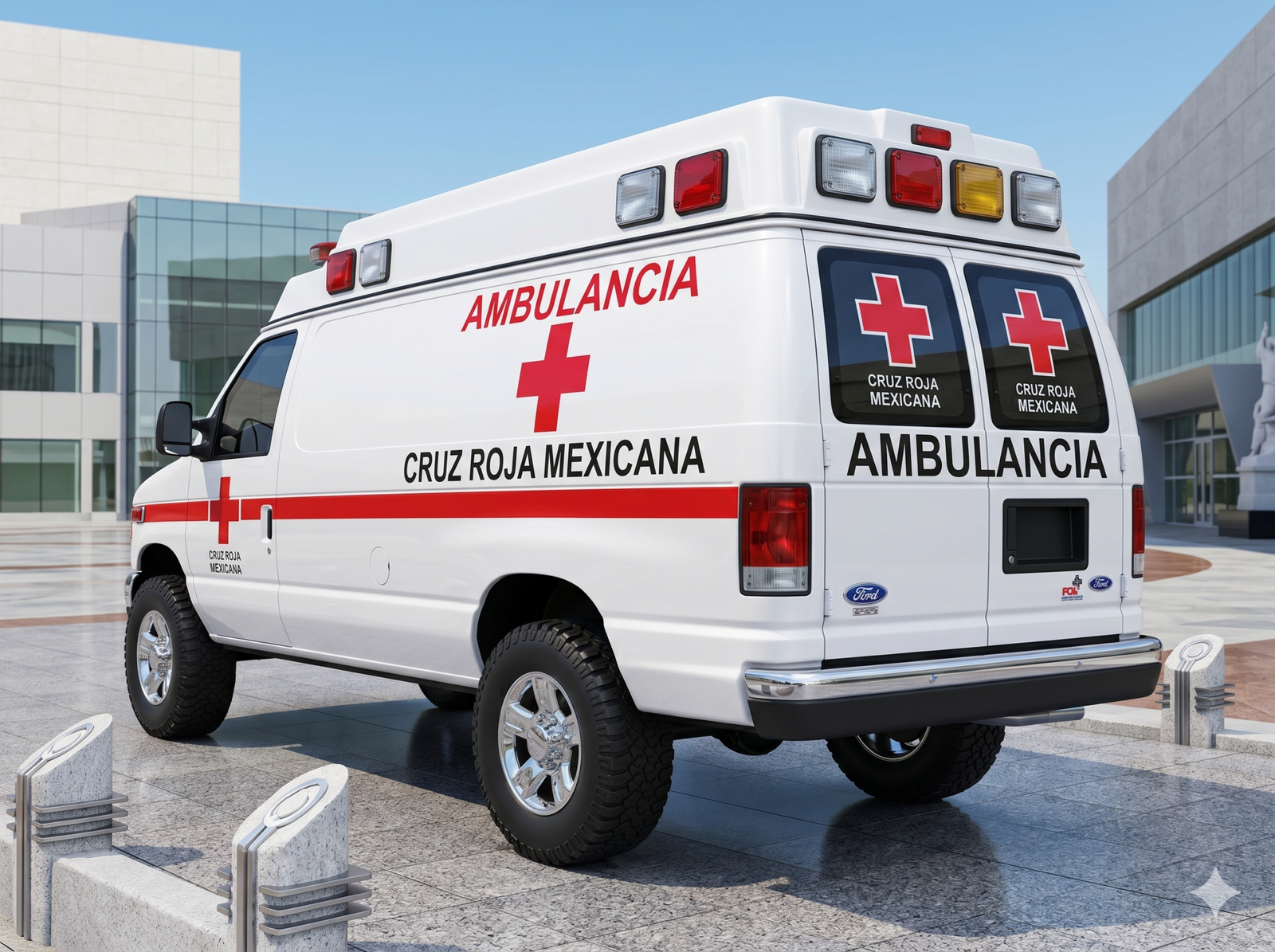
The Mexican Red Cross (Cruz Roja Mexicana) provides most prehospital emergency response in Mexico. The people who staff those ambulances are dedicated and often heroic. However, the organization is chronically underfunded. The unit that responds to your 911 call may have basic equipment compared to what you’d expect from a U.S. paramedic crew. The personnel may not be paramedics in the U.S. sense of the word. That process can determine the difference between life and death.
You won’t have a choice in the hospital you’re taken to.
The ambulance will take you to the nearest hospital regardless of your preference. If that hospital is full, then they’ll take you to the second closest. Once you get to the hospital, you may not have access to English-speaking staff or doctors.
PLEASE NOTE: None of this is a criticism of the people doing the work. It’s a description of the system you’re depending on if 911 is your first call.
Why a private ambulance is the better first call
Here is what most foreign residents in Mérida don’t realize until they need it: there are private ambulance services that charge an affordable cost. Call the service directly to take you to the hospital of your choice.
When you call a private ambulance directly, several things happen that don’t happen when you call 911:
- You speak directly to someone who can help you and dispatch an ambulance to your address.
- The ambulance that comes is staffed by people trained to deliver you to your specific hospital of choice.
- You skip the prank-call filter entirely.
- You skip the patrol-car screening protocol entirely.
- You arrive at a hospital that has been told you’re coming, and what’s wrong.
There is a cost, of course. Private ambulance services charge — usually a few thousand pesos. The cost and what services are provided is worth knowing about in advance, not discovering in the middle of a crisis.
Local Tip: Before you have a medical emergency, ask a Spanish-speaking friend to help you and ask: What is the cost of an ambulance? Are there any protocols to follow when requesting an ambulance? Are there any English-speakers available? Write the answers down and keep them handy. Google “Ambulancias de traslado en Mérida Yucatán” for a list.
The “closest appropriate facility” problem
When Calling 911 in Mérida, the police arrive to your house and call an ambulance for you. That ambulance does not take you to the hospital of your choice. It takes you to the closest appropriate facility — and “appropriate” is defined by the ambulance crew, not by you.
The closest hospital may not be where you are comfortable or where the language situation is workable for you. You may end up at a hospital you aren’t familiar with and unable to communicate easily — at the worst possible moment to be trying to explain yourself.
Your pre-emergency checklist
Most of the work of handling a medical emergency well in Mérida is done before there is an emergency. Here is the list I keep, and the list I give to every friend who arrives in the city.
Pick your hospital. Read up on Mérida’s major private hospitals and pick the one that makes sense for you based on where you are most comfortable. This can be location, communication and price. If you haven’t done this yet, start here: Going to a Mérida Mexico Hospital? Here’s How the System Actually Works.
Local Tip: We have a relationship with Hospital Faro del Mayab (Christus Muguerza). We can schedule a tour for you with about 5 business days’ notice. Send an email to: amy@lifeinmerinda to schedule it.
Save the right information.
In your wallet or purse, create a list called Emergencia.
Record these numbers:
- hospital of choice and address
- name and contact of local primary care doctor
- if you have Mexican National insurance, include contact information and policy number
- for foreign insurance, include contact information and policy number
Include critical details:
- allergies
- surgeries
- medical issues
- blood type
- medications
- other information such as pacemaker, etc.
Local Tip: The reason I recommend placing this in your purse or wallet and NOT your phone is that 99.9% of people have some kind of locking system, code, fingerprint or facial recognition to unlock their phone. If you are unconscious and someone is trying to help you, keeping information on your phone doesn’t work.
Pin three hospitals on Google Maps.
Not just your primary preference but a back up and one that is close.
Establish a relationship with a primary care doctor.
A doctor who knows you and your medical history is one of the most valuable medical resources you can build in Mérida.
Local Tip: We HIGHLY recommend Dr. Jose Azcorra. We’ve seen him for the past 6 years, he’s fluent in English, high-level of commication, and a wealth of knowledge and resources. Establish a relationship with him before you have an emergency. WhatsApp +52 999.297.4394
Learn five Spanish phrases.
Even if your Spanish is limited:
- Necesito una ambulancia — I need an ambulance
- Es una emergencia — It’s an emergency
- Mi dirección es… — My address is…
- Tengo dolor en el pecho — I have chest pain
- ¿Habla inglés? — Do you speak English?
Sort out power of attorney.
If you live alone, or if your spouse is the one most likely to be incapacitated, someone needs to be legally able to make medical decisions on your behalf. This is a conversation to have with a Mexican Notario now, not after something has gone wrong.
Local Tip: Need a trustworthy Notario with full legal services? Get in touch with Alonso Hernandez of Notario 63. He has a full team of legal professionals that can assist with contract review, real estate, businesses, and other legal matters such as wills and powers of attorenys. Send an email to: alonso@n63.com.mx – Be sure to let him know we referred you!
A critical component most foreigners are NOT aware of. You will need an advocate to be with you in the hospital.
While there are nurses on staff, their primary (and only) job is to provide medical-related services such as taking vitals, assisting the doctor or other medical staff, etc. Need a glass of water? ice? pillow fluffed? These are what your advocate is for.
Another thing to be aware of is if you are unconscious. Your advocate can make medical decisions on your behalf (of course, the ones you’ve discusssed in advance). While we all want to believe that the inevitable won’t happen or we can do it/handle it ourselves, you are better served making decisions when you have a clear mind vs. emotional decisions in the moment or not having the option at all if you are unconscious or incapacitated.
When calling 911 in Mérida is the right call
I am not telling you to never call 911 in Mérida. There are real scenarios where 911 is the right first call:
Crime in progress.
If you are being robbed, threatened, or you witness violence, 911 is the number.
Fire.
Call 911 for fires. Mérida’s bomberos are dispatched through this number.
Car accidents with injuries.
Police need to be on the scene to document the accident, and 911 will dispatch both police and medical response.
Public emergencies.
Someone collapses in the street, a tourist is in distress, a child is lost — these are 911 situations.
You’re alone, conscious, and not sure where to turn.
911 will at least get someone to you, and assess the situation and call for medical attention if needed.
The point of this article is not to bypass the emergency system. It’s to make sure that when something serious happens to you or someone you love in Mérida, your default reaction isn’t a reflex you imported from the country you left. The default reaction in Mérida — assuming you’ve done the work in advance — should be a call directly to a private ambulance with 911 as a backup for the situations that don’t fit that pattern.
A final thought
There is a version of moving abroad that involves importing every assumption you arrived with and being puzzled when reality doesn’t match. There is another version that involves learning how the place you actually live works, and adapting accordingly.
Emergency medical response is one of the places where the two versions diverge most sharply. The number you grew up calling — 911 — is the same number on the keypad here. What happens after you dial it is not the same.
Do the work now. Pick your hospital. Save the numbers. Print the sheet. Have the conversation with your spouse or partner about who calls whom and when. The middle of an emergency is not the time to figure any of this out for the first time.
For additional information about medical emergency services, hospitals, insurance and other questions or concerns that are health-related, check out Expat Insurance and Health Itinerary. We have a long-standing relationship with owner, Pati Sales. She and her team offer an amazing package of resources and insurance plans. She will not oversell you, ensuring you have the best product for your needs and your budget. For a no-obligation quote, start the process here: https://form.jotform.com/241906454284864
— Amy Jones, The Mérida Ambassador
